Asosiy kontentga oʻtish

Kurash

Kurash tarixi

Ming yillik oʻzbek anʼanasidan xalqaro sport turigacha bosib oʻtilgan yoʻl.

12 daqiqa oʻqish

Kurash tarixi

Tarix

Kurash that is attracting millions of people round the world has its long rooted history. As researchers, historians say and according to archeological investigations Kurash originated at least 2500-3000 years ago. It can be proved by rare finds, pictures drawn on rocks in several regions of Uzbekistan including Zarafshon, Surkhon and Fergana.

There are six finds - corporeal evidences that can prove the history of Kurash on scientific basis. The picture drawn on the wall in Panjikent (lsl photo) goes back to Sugd state time i.e. medieval period. One of such evidences is the cylinder shape ware made of clay found in ancient Baktria (west of Uzbekistan) region. On this ware there are two wrestlers depicted and one of them is sweeping his opponent. There are several more evidences from bronze period that prove the history of Kurash goes back to 3500 years.

The second find is from bronze period, which are two horseshoes (2nd photo). Both horseshoes depict Kurash techniques. According to professor M.P. Graznov's words, they were made in accordance with sak-skiff tribe's spiritual view and are related to initial stages of nomad life.

Other evidences found in Chelak area near Samarkand prove the long history of Kurash. Among all the ware with geometric engraves the handle of the silver cup shows two athletes performing techniques like in Kurash. This find is from middle ages. (4,h photo).

According to ethnographic researches, ancient tales, stories and narratives also contained episodes about Kurash. Paying attention to their meaning we understand that they pertain to matriarchy period which means the history of Kurash is as long as 5000 years.

There were 3 kinds of Kurash custom in Uzbek people's life. The first one was as a physical exercise and connected with wedding ceremonies. The bout between the groom and the bride was arranged by the reigning women of that time. This happened because of the right of choosing and testing the groom given during the matriarchy kingdom. (5th and 6lh photos).

According to M.O. Kosven's "Outline of ancient culture history" book, published in 1980s, during matriarchy period weddings were arranged by the initiative of brides. Traditions changed as time passed and contradictions towards patriarchy also took place at that time. Later girls would agree to get married if the groom wins her in one-to-one battle. Besides, in petrography (pictures on rocks) women are bigger and stronger than men. This could support the believ that strong and great athletes are born by physically strong women. History also proves that in the past there were women who would govern states. Great scholar and historian Abulghoziy Bohodirkhan (in 1643-1663 ruler of Kharezm region) gives interesting information in his "Shajaraiy tarokima" about seven female rulers. There several memorial stones and statues brought up in favor of female rulers.

The third example of epic Kurash is the choice made by the bride out of candidates to be a groom. In this case the bride does not fight but keep the right to put a condition and make a choice. Such kind of episodes can be found in world epos as "Alpomish", "Odissey" and "Ramayana".

According to ethnographic researches Kurash was widely developed in the area of Uzbekistan in IX-X A.D. and it became a tradition to organize competitions during public holidays and feasts. As S.P. Tolstov writes during public holidays, especially Nauroz holiday a big attention was paid to organizing Kurash competitions.

At such holidays first three days Kurash performances were organized by old-aged people of the land with streets full of people. Prisoners were released, guilty people forgiven because of these events. One of important things is that Kurash performances were a good example of physical education for young children.

In uzbek folklore like "Alpomish", "Gurugli", "Avazkhon", "Rustam", "Tulganoy", "Kuntugmish" Kurash athletes were mentioned and strong, courageous, smart ones praised. In ancient Chinese manuscript "Tan-shu" constant Kurash events organized in Fergana valley region were also mentioned. An arab geographer and traveler who lived in X century also says about often held Kurash contests in Marv, Samarkand, Bukhara and Balkh regions.

The great healer Avisenna (980 - 1037) wrote with emphasis in his book "Canons of Avisenna" that Kurash is very important for the spiritual and physical condition of a person. According to his words person doing physical exercises on constant basis would not need medical assistance.

In oriental literature like "Shokhnoma", "Kobusnoma", "Zafarnoma", "Boburnoma" and "Abdullanoma" brilliant features of Kurash athletes, their spiritual world are well described. Alisher Navoi also enjoyed Kurash and supported people who promoted it worldwide. This is the reason of many stories, episodes about athletes to appear in his works. In the special biography dedicated to athletes "Holoti Pakhlavon Mohammad" it tells about the unbeatable athlete of his time Pahlovon Mohammad, his perfect knowledge in the religious and secular sciences, including astronomy, mathematics, chemistry, philosophy, literature, art, law and other sciences as well as emphasizes his poetic ability. Poets of that time would take advice from Pahlavon Mohammad who practiced Kurash constantly, and show their new works to evaluate them. He was also a great healer. Famous healers like Mavlono Kutbiy, Mavlono Alomulk and Mavlono Abdusalom would discuss with him and used Pahlavon Mohammad's methods of curing in their activities.

Amir Temur who created a powerful and great state was not only the statesman, ruler and commander, but also mastered the knowledge of kurash in perfection. This was the reason of the great attention to be paid to the development of physical readiness, love for the motherland among youth. Sharofiddin Ali Yazdiy in his "Zafarnoma" and Alisher Navoi in "Nasoyil ul-muhabbat" presented interesting and useful information about hundreds of athletes like Babohoki (originally from Shibirgon area, north of Afghanistan), Uchkora bohodir and Abbos Usmon jaloy (originally from Karakul area of Bikhara region). Hazrati Pahlavon Babohoki was also acknowledged as a saint, Uchkora bahodir had a big land (presently the famous rasin from Hatirchi prefecture is called «Uchkora rasin» and planted in the area), Abbos Usmon jaloyir was very brave in the battle against Tukhtamish army (1939). He was murdered at his 25 years of age by enemies. As people of that time wrote Pahlavon Bobohoki lived 122 years and Uchkora bohodir 110 years. The long lifes of these people show that to be an athlete and healthy manner of life are connected with long life.

From history we can see that before the start of a battle between two armies the commanders would come out to wrestle against each other and the commander that wins the match would be the winner preventing the blood-shed and country from which he came would be considered as the winner of the war.

Great scholars of XV century Husayn Voiz Koshifiy and Zayniddin Vosifiylar also emphasized in their books the scientific, spiritual, enlightment features of Kurash. For example, Koshifiy writes in his «Futuvvatnomai sultoniy» story-book: «One should know that Kurash is something interesting for people, acceptable by kings and sultans. People who train Kurash always live with idealogy of justice and purity.

If someone asks the meaning of Kurash the answer is the things happening in mankind"s inner world, because people change their behaviour. The truth of this word is that in the inner world of mankind there is always a battle between good and evil, in other words every good attribute tries to eliminate its opposite one. Kurash means this feature in the person"s inner world...»

In historical books of other centuries there is also a lot of information about Kurash athletes. For example, in the north of Bukhara region one of the historical gates is still called «Uglon».I-Iistorian Hafiz Tanish Bukhariy writes in his book «Abdullanoma» that at the war to occupy the Badahshon area the army could not beat the rivals because of the ark gate and the athlete whose name was Uglon came and shaking the gate threw it on the ground and the area was occupied (1586). After he died the new gate built in the historical capital was named after the athlete Uglon and it is still called with this name.

There is also more information about the great saints of our people who also happened to train Kurash. For example, the burial-vault of Sheikh Hudaydod Azizkhon in Gazira village of Samarkand region is now considered a sacred place. Who is Sheikh Hudaydod Azikhon? As B. Valikhodjaev and B. Urinboev wrote in «Hudaydodi Valiy», the great saint Sheikh Hudaydod Azizkhon"s father had been originally from Kharezm region and initially moved to Bukhara region and living there for sometime moves out to Karmana town, and then from there moves to a village in the east. At this very village in old Ortik sheikh"s house a child had been born and they named him Hudoyberdi. In 1480 in Bukhara he happened to meet with the representative of Yassaviy"s follower Sheikh Jamoliddin and became his student. Sheikh Jamoliddin warmly welcomed Hudoyberdi and gave him a penname «Hudaydod». After studying at madrasah of Samarkand, Gijduvon and Bukhara he returned to Karmana town in 1484, he perfectly learned the Yassaviy phylosophy. In the beginning of 1490 he headed to the capital -Bukhara being informed that ruler of Karnab area suppressed people. He participated in matches during the Nauruz feats and when he beat all his opponents the Governor of Bukhara Temuriyzoda Mukhammad Bokiy Mirzo asked him what he would have liked for the prize, he said to fire the ruler of Karnab area from his position. After the ruler was released from his position the people of villages relieved from pressure. In the beginning of 1500s Sheikh Hudaydod Azizkhon moved to Samarkand and passed away there in 1532. The biography of the sheikh and athlete written when he was alive is now available for the present generation and kept in funds of Uzbekistan, some of the uzbek traditional and pleasant poems from that script have been published in republican and regional publications.

There is information that a famous follower of Nakshbandiy phylosophy Sayyid Amir Kulol (lived 1301-1372) also practiced kurash. His grave is located in Sukhor area of Kogon region and is considered as a sacred place.

Uzbekistan is very rich with valuable sourses about athletes, lived in B.C. and A.D. centuries illustrated in ancient manuscripts,are waiting for the researchers to observe them. One of them, «Risolai goshtingiri» («Article of kurash athletes*) is also amondg these books, in this book feith and behaviour of athletes are thoroughly written.

Historical Kurash athletes of Uzbekistan can be divided into three groups:

1) Sipohi (strong) pahlavon - athletes that practiced Kurash and fought in war (ex. Pahlavon Bobohoki);

2) Gushtingir (athlete) pahlavon - athletes that practiced Kurash, involved with science and education, pertain to sufism phylosophy (ex. Pahlavon Makhmud and Pahlavon Mukhammad);

3) Ustod pahlavon - athletes that did not participate in Kurash matches, wars, but prepared kurash students (Usullikota, Chukurdamota).

Kurash that had been formed for centuries and played an important role in perfection of humans, for 130 years of dominance of soviet union was under pressure and got weakened. The totalitarian regime allies tried to cut down the traditions like Kurash that inspired people waking the feelings of pride and glory in dormant souls of people. This was the reason Kurash could not reach the international area during the reign of soviet regime..

Even though loyal to Kurash athletes organized kurash in small circles that gave to people spiritual pleasure. Only after the independence of Uzbekistan a new spirit was given to Kurash and holidays, feasts were joint by Kurash.

Kurash that passed difficult tests with courage, and has been accepted as a symbol of truly brave people, good will and goal, today turned into an activity of people, important issue of the count and government. Several years have passed since it gained the love of world community and became an international sport in the world arena.

Starting from 1991, the year Uzbekistan became independent state, the first President of Uzbekistan His Excellency Islam Karimov, the initiator and inspirer of all historical changes in Uzbekistan, the man who made crucial contribution to Independence of Uzbekistan, formulated the goal to promote Kurash worldwide as a new international sport. President Karimov while meeting Komil Yusupov in 1992 gave his ideas on the ways to make the sport of Kurash an international one and through this sport introduce Uzbekistan, its history, traditions and philosophy to the world.

After that meeting using the support of the Uzbek President, the group of activists of Kurash led by Mr. Yusupov started the international propaganda and promotion of Kurash. They held several big tournaments in different parts of Uzbekistan using the new rules – the success was overwhelming. Sometimes the large stadiums could not accommodate all spectators. The group made presentations at various prestigious sport forums in South Korea, Canada, Japan, India, USA, Monaco and Russia. And the goal was soon reached.

In September 1998 the capital of Uzbekistan – Tashkent held the fist ever international Kurash tournament. Players from almost 30 countries of Asia, Europe and Pan America participated. Usually the Kurash event in Uzbekistan are held at the football stadiums. This tournament, which was for the Prize of the Uzbek President, was not an exception.

During this tournament Tashkent hosted another historical event. On September 6th 1998 representatives of 28 states of Asia, Europe and Pan America established the International Kurash Association – the official international sport organ representing Kurash in the world. Since that day September 6th is the official birthday of the new international sport – Kurash. Delegates of the first inaugural Congress ratified the Statutes of the new organization and the international rules of Kurash, elected the managing body of the IKA- the Directing committee. Islam Karimov, the president of Uzbekistan and one of the key person in the international promotion of Kurash was elected as the Honorary President for life, Komil Yusupov, the author of the Kurash rules, became the President of the IKA.
Kurash

Musobaqalar qoidalari

1998-yil 6-sentabrda IKA taʼsis kongressida qabul qilingan xalqaro qoidalar.

  • 34 ta band
  • Tashkilot va hakamlar
  • Sportchi, kiyim va jihozlar
  • Bellashuv va baholar
  • Musobaqa tartibi
Musobaqalar qoidalari

Tashkilot va hakamlar15

  • 1Regulations On Competition

    The regulations on competition are drawn up and approved by organization, which arranges this competition. The regulations should include the following:
    1. Type of competition;
    2. Purpose of competition;
    3. Sport features, age, sex, name of teams and organizations;
    4. Place and date of conducting of competition;
    5. Order of conducting of competition;
    6. Conditions of participation in competition;
    7. Responsible organization for conducting of competition;
    8. Board of referees;
    9. Fight duration;
    10. Deadline for submitting applications for participation in competition;
    11. Medical control procedure and maintenance of order;
    12. Documents to be submitted to credentials committee;
    13. Claims submission procedure and their consideration;
    14. Date and time of conducting of competition in each weight category;
    15. Procedure of rewarding of winners and prize winners of competition.

  • 2Types of Competitions

    1. Individual championship.
    2. Team championship.
    3. Individual and team championship.
    4. Open gilam (tatami) championship.
    5. Absolute championship.
    a. individual championship is held to determine the strongest wrestlers of the competition.
    b. in team championship the place of every team is determined.
    c. in individual and team championships the place of every participant is determined and according to it the place of every team is determined.
    d. in open gilam (tatami) championship every wrestler fights to increase his/her sport qualification, title and experience.
    e. in absolute championship the strongest wrestler is determined irrespective of weight category.

  • 3Board of Referees

    1. Prior to conduction of every competition the federation, conducting this competition on its territory, submits a list of referees, approved by this federation. Every competition from the calendar of international tournaments, continental championships, World Championship and Olympic Games, may be attended only by referees, authorized by the International Kurash Association.

    2. Structure of the Board of referees:

    a. Chief Referee;

    b. Сhief Referee deputy, their number should be more by one, than number of gilams (tatamis), on which the competition is held;

    c. Chief Secretary and secretaries of gilam (tatami);

    d. Arbitrator and side referees;

    e. Stop-watch referee;

    f. Scoreboard referee;

    g. Informing referee;

    h. Warden of competition;

    i. Medical staff (doctor of competition).

    3. Referees, entering gilam (tatami), put their right hand on left part of breast and simultaneously bow to spectators and Chief Referee.

    4. Chief Referee and Board of referees control referees’ actions. If referees admit actions contradicting the rules of competition, they are discharged from competition and deprived of their referee’s license.

  • 4Chief Referee

    Chief Referee is the head of competition, responsible for holding competition according to the rules. Participants, team representatives, board of referees and attendants should implicitly execute instructions of Chief Referee.

    1. Chief Referee’s Responsibilities:

    a. to control accordance of a sport building (gymnasium or stadium), equipment and gilam (tatami) with competition requirements;

    b. during the drawing to divide the strong wrestlers in two subgroups;

    c. to distribute referees on gilams (tatamis);

    d. to make the schedule of competition;

    e. to nominate referees for wrestlers scaling;

    f. to nominate referees to each fight and to supervise their actions;

    g. prior to the beginning of competition, to hold a meeting of Board of referees;

    h. daily after the end of competition, to gather team representatives, Board of referees and coaches, to summarize competition’s results, eliminate complains, received during competition.

    i. if necessary, to hold an assembly of Board of referees;

    j. to evaluate readiness of referees for competition and the course of competitions;

    k. to fill in and to hand over the reporting minutes on holding and results of competition to appropriate bodies.

    Rights of Chief Referee:

    a. to suspend and to forbid conduction of competition if the place of conduction, equipment and gilam (tatami) are not prepared and do not meet rules requirements;

    b. to temporarily suspend competition, if there is something that may negatively affect conduction of competition on the high level;

    c. to make changes in the procedure of conduction of competition or the schedule of competition;

    d. to discharge referees for violation of rules and give information about it to the Board of referees;

    e. to discharge the wrestlers who violated rules or does not have permission for participation in competition;

    f. to give cautions or to discharge a coach of any team for violation of Kurash rules or for inappropriate behavior during competition.

    Note: Chief Referee has no right to cancel or change Kurash rules.

  • 5Chief Referee Deputy

    1. during temporary absence of the Chief Referee at competition, fulfills his/her responsibilities;

    2. announces results of fight and names of wrestlers fighting next;

    3. announces results of fight and names of wrestlers fighting next;

  • 6Chief Secretary and Secretaries

    1. The Chief Secretary examines the documents of wrestlers while they pass the credentials committee.

    2. The Chief Secretary keeps the minutes of assembly of Board of referees, of fights and other documents.

    3. Secretaries keep the minutes of gilam (tatamis).

    4. Secretaries write down results and remarks on fights in the minutes.

    5. The Chief Secretary together with Chief Referee is obliged to fill in and to sign the minutes-report of the competition.

  • 7Arbitrator

    1. Before the beginning of a fight, the arbitrator examines the condition of the wrestler, accordance of his/her uniform with Kurash rules, if there is a disparity, he should demand to change the uniform (in prescribed time).

    2. The arbitrator controls the course of the fight and observance of Kurash rules.

    3. Takes into account appraisals of side referees.

    4. After every appraisal of the implemented methods, the arbitrator should stop the fight (with a command TOKHTA!), give appraisal during 2-3 seconds and begin wrestling with a command KURASH!

    5. While announcing cautions for violation of rules the Arbitrator should stop (with command «TOKHTA») the fight and in 15-20 seconds should announce cautions (in this period of time wrestlers should remain on their places and put in order their uniforms) and begin it with command «KURASH».

    6. Once the stop-watch referee signals the end of fight time, the arbitrator should stop the fight with a command VAKT! and an appropriate gesture.

  • 8Side Referees

    1. Side referees should help the arbitrator to evaluate all actions of the wrestlers.

    2. Three referees on majority basis evaluate all actions of wrestlers on gilam (tatami). If opinions of three referees do not coincide, they must discuss it to get final opinion.

    3. Side referees sit on the opposite parts of gilam (tatami), and if there is no such a possibility, they may stand watching the course of the fight.

    4. If a participant needs to leave gilam (tatami) for a short time, he should be accompanied by one of the side referees.

  • 9Stop-Watch Referee

    1. The stop-watch referee watches the duration of the fight and the time when the wrestlers come on gilam (tatami).

    2. The stop-watch referee calculates and controls every minute of fight time. If the wrestler uses medical help during the fight or wrestling is stopped because of any other reason, the stop-watch referee counts the duration of stop and informs immediately Chief Referee.

  • 10Scoreboard Referee

    1. The scoreboard referee shows on the score-board all appraisals and cautions announced by the arbitrator.

    2. If the scoreboard referee has not enough time to see or to hear the result announced by the Arbitrator, he/she asks about it the secretary of gilam (tatami).

    3. Appraisals should remain on the scoreboard until the winner is announced.

  • 11Informing Referee

    1. The informing referee announces the schedule of the day, weight categories, names of the next pair of wrestlers to fight. Gives the information on each wrestler entering gilam (tatami). Also gives the information to spectators about the referees on gilam (tatami).

    2. All information on competition is given only after approval by the Chief Referee or his/her deputy.

  • 12Warden Of Competition

    1. The warden of the competition is responsible for readiness of the gymnasium, stadium or field where the competition will take place, gilam (tatami) on which the fight will be held, referees’ table and chairs and other accessories;

    2. The warden of the competition is responsible for the order during the competition.

    3. The warden of the competition conducts his/her activity in accordance with orders of the Chief Referee.

  • 13Doctor Of Competition

    1. Before the beginning of the competitions the doctor of the competition examines medical reference of the wrestler, signature and seal, if there are defects, does not allow the wrestler to fight.

    2. The doctor of the competition examines the wrestlers during scaling.

    3. The doctor of the competition controls cleanliness of the place of the competition and gilam (tatami) of the fight, the wrestlers uniforms.

    4. The doctor of the competition treats the wrestlers injuries during competition.

  • 14Situations Not Stipulated By Kurash Rules

    1. Situations not stipulated by Kurash rules are solved by the Board of referees.

  • 15Referee Uniform

    1. The referee uniform includes a black suit and trousers, black socks, white shirt and black tie.

Sportchi, kiyim va jihozlar8

  • 16Kurash Uniform

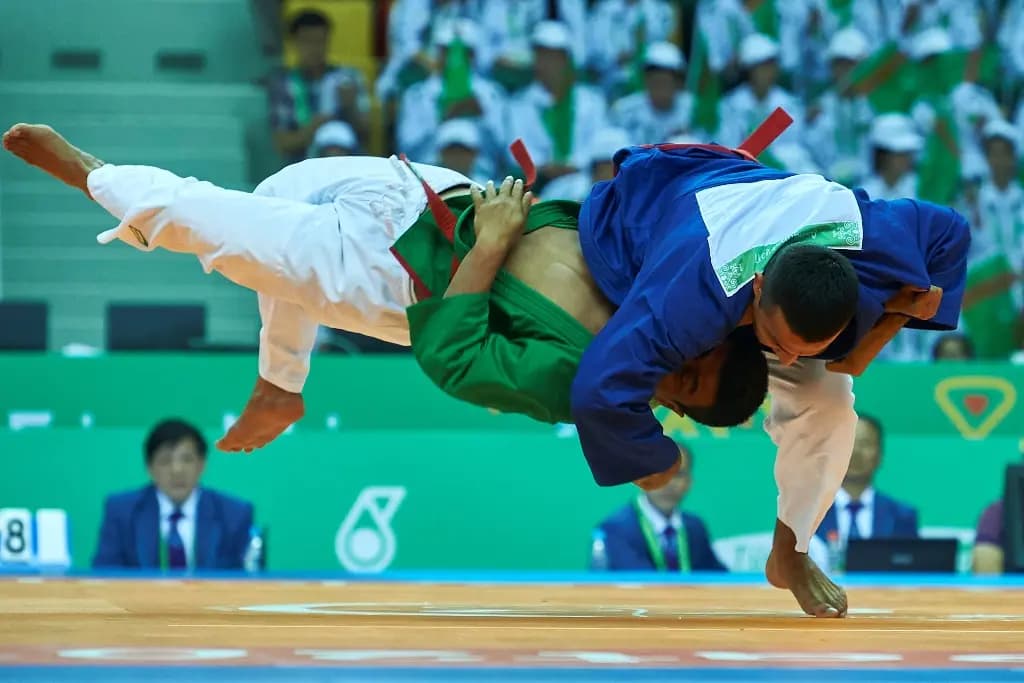
    1. The participants of the competition should wear a dark blue or green yakhtak, white trousers, a red belt. And, the participant called first comes in a dark blue dressing gown, and the second one — in a green dressing gown. Types of colors used: blue — 5-zm; green — 4-kx.

    2. The uniform should be made from cotton, be in good condition, the material should not be very rigid or dense.

    3. The following marking is allowed:

    * State Emblem (on the left part of breast, maximum size: 10х10 cm);

    * trade mark of manufacturer (3х3 cm in front below the jacket);

    * shoulder marking (not more then 25 cm, width up to 5 cm);

    * tabs (25х25 cm, allowed on back, may include wrestler’s surname).

    4. The yakhtak should be 15-20 cm above knees. The yakhtak sleeves should not cover wrists. 8 cm should be between a hand and a sleeve. The trousers should be up to feet. 15-20 cm should be between a trouser-leg and a leg. A belt should be 4-5 cm in width. It should be such in length that after two turns round the waist and tying up, the ends still have not less than 20 cm in length.

    5. Women-participants should wear a durable white sports shirt or tricot with short sleeves under their yakhtak, tucked into trousers.

    6. If a yakhtak of a participant does not meet the requirements, the arbitrator should require from participant to change yakhtak. Participant must draw out his/her hands before him/her and thus show the arbitrator that the length and width of yakhtak sleeves correspond to the rules.

    7. The wrestlers of both sexes wrestle on bare feet.

  • 17Hygiene Of The Wrestlers

    Clothes of participants (yakhtak and trousers) should be clean, dry, without a bad smell. Nails on hands and feet should be shortly cut. Long hair should be assembled, in order not to cause inconveniences to the other wrestler. Any participant violating rules of hygiene, loses his/her right to participate in competition.

  • 18Gilam Of Competitions

    1. Kurash gilam should have minimum size 14х14 m. The maximum size is 16х16 m, it should be covered with a fabric, colored usually green, white, red, light-green, dark blue.

    2. Gilam of competitions is divided into two zones. The line dividing these zones, is called «the dangerous line», it is always red and 1 m in width.

    3. The fight area inside the line, including the dangerous line itself, is called «the safe zone», with minimum size 8х8 m, and maximum size 10х10 m.

    4. The zone beyond the red line is called «the dangerous zone», 3 m in width.

    5. The white lines 1 m in width and 2 m in length on two sides, designate the place of beginning and end of fights. These lines are drawn in the safe zone no more than in 6 m from each other.

    6. The gilam should be on an elastic floor or a special platform. There should be a free zone not less than 1 m in width surrounding the wrestling spot. Kurash gilam is made in following sizes:

    200 х 100 х 4 cm or 5 cm

    150 х 100 х 4 cm or 5 cm

    100 х 100 х 4 cm or 5 cm

    12 х 12 m 14 х 14 m 16 х 16 m
    Red 18 pcsLight green 30 pcsWhite 2 pcsBlue 11 pscGreen 11 pcs Red 18 pcsLight green 30 pcsWhite 2 pcsBlue 24 pcsGreen 24 pcs Red 18 pcsLight green 30 pcsWhite 2 pcsBlue 39 pcsGreen 39 pcs

    Made as following: Sheet is open from below, red / light-green / white / dark-blue / green; paralone of second-time foaming, knotted with special tent.

  • 19Equipment

    1. At each gilam (tatami) there should be:

    * a table and three chairs

    * two light chairs

    * a stop watch

    * a microphone

    * a score-board (showing the pure time of a fight) with a sound signal of the end of fight.

    2. Two light chairs should be located in the safe zone in the opposite corners, not closing the score-board.

    3. The score-board should be located outside the working zone so that referees, members of the Board of Referees and spectators can easily see it/them (there always must be in reserve a mechanical score-board for control). The score-board should meet the requirements of the International Kurash Association.

    4. In case of use of electron clock, mechanical clock is used for control.

    5. Gong or a sound device should be used to signal the arbitrator about the end of the fight.

    6. Spectators (press, TV, etc.) should be not closer than 3 m from the gilam (tatami) of competition.

    7. Manual stop watches (chess clock) and scoreboard should be used simultaneously with electronic equipment in case of failure of electronics.

  • 22Weigh-in Procedure

    1. Participants of one weight category are weighted on the same day, on the same scales, two hours before the competition.

    2. The weight-in should proceed no more than one hour.

    3. At weight-in wrestlers should have their identification cards.

    4. Without being weighted a wrestler is not admitted to competitions.

    5. During weight-in wrestlers should wear only shorts or swimming trunks.

    6. At weight-in of wrestlers, there should be a commission composed of the Chief Referee, the Chief Referee deputy, secretary, medical staff member, 2 or 3 referees. After weight-in, surnames of wrestlers are written in the minutes of scaling.

  • 23Age And Weight Category Of The Wrestlers

    1. Age and weight categories for male players:

    1. Children (4-7 years) – 8, 9, 10, 11, 12, 13, 15, 17, 19, +19 kg

    2. Children (8-11 years) – 20, 21, 23, 25, 27, 30, 33, +33 kg

    3. Children (12-13 years) – 33, 36, 40, 44, 48, 52, 56, 60, 65, 70, +70 kg

    4. Cadets (14-15 years) – 38, 42, 46, 50, 55, 60, 65, 71, 77, 83, +83 kg

    5. Juniors (16-17 years) – 42, 46, 50, 55, 60, 65, 71, 77, 83, 90, +90 kg

    6. Seniors (18-35 years) – 60, 66, 73, 81, 90, 100, +100 kg

    7. Veterans (age groups:36-45, 46-55, 56-60, 61-65 years and above) – 60, 65, 70, 75, 80, 85, 90, 95, +95 kg

    2. Age and weight categories for female players:

    1. Children (4-7 years) – 8, 9, 10, 11, 12, 13, 15, 17, +17 kg

    2. Children (8-11 years) – 18, 19, 20, 22, 24, 27, +27 kg

    3. Children (12-13 years) – 30, 33, 36, 40, 44, 48, 52, 57, +57 kg

    4. Cadets (14-15 years) – 33, 36, 40, 44, 48, 52, 57, 63, +63 kg

    5. Juniors (16-17 лет) – 36, 40, 44, 48, 52, 57, 63, 70, +70 kg

    6. Seniors (above 18 years) – 48, 52, 57, 63, 70, 78, 87, +87 kg

    3. Irrespective of the weight category, youths and adults can (with the sanction of the Chief Referee) participate in competitions in absolute weight category.

  • 25Requirements To Wrestlers

    1. The participants of competition are required to have the following:

    a. identification card, above mentioned uniform, document verifying wrestler’s class;

    b. team application, permission of doctor with a seal. All these documents are examined before the competition by credentials committee and are approved by the chief doctor and members of committee. The chiefs of teams are responsible for meeting conditions and requirements mentioned above.

    2. With the sanction of the Chief Referee, youths (16-17 years) may also participate in adults competitions.

    3. Wrestlers competing in one weight category are not permitted to participate in another weight category, but they may wrestle in absolute weight category with the sanction of the Chief Referee.

  • 26Responsibilities Of The Participants

    The participants of competition should observe the following rules:

    1. greet one another by a bow before the beginning and after the end of the fight.

    2. observe all Kurash rules and rules of competition.

    3. obey the referee’s instructions.

    4. behave correctly during competition.

    5. if referee calls a wrestler, he/she should immediately go to the designated place.

Bellashuv va baholar7

  • 20Beginning And End Of Fight

    1. Before the beginning of every fight three referees (arbitrator, two referees) come together on the edge of the gilam (tatami) and, putting right hand to the left part of breast, bow and then take their places. Getting off the gilam (tatami) the referees come together on the edge and bow again with the their right hands on left breast.

    2. The participants with their right hand on the left breast, should bow before coming in the safe zone. After bowing before the safe zone the participants should move forward up to the specially marked place, then, with right hand on left breast, they must bow to each other.

    3. After the arbitrator announces the result of the fight, the participants with right hand on left breast, should bow to each other.

    4. Arbitrator and side referees should take their places before the fight prior to participants’ coming on gilam (tatami).

    5. All bows are executed by bending in waist forward. If participants do not bow, the arbitrator should require their bowing.

    6. Examining the fight square before the fight, referees should check if the gilam (tatami) surface is plane, clean, without slots between mats, the chairs of referees are on their places, the participants meet the requirements of the rules. The arbitrator should be in the center of the gilam (tatami) initially facing the time-registration table.

    7. The arbitrator when giving a command TOKHTA! should see the participants.

  • 24Bout Duration

    1. Males:

    from 4 to 11 years — 2 minutes of pure time

    from 11 to 16 years — 3 minutes

    from 16 to 35 years — 4 minutes

    from 35 to 56 years — 3 minutes

    from 56 years and above — 2 minutes

    2. Females:

    from 4 to 16 years — 2 minutes

    from 16 to 35 years — 3 minutes

    from 35 years and above — 2 minutes

  • 27General Kurash Rules

    1. In Kurash wrestlers wrestle according to the adopted rules. Methods are evaluated by referees.

    2. if wrestlers have equal appraisals than victory is given according to the last appraisal.

    3. if a participant has an appraisal and a caution, the appraisal has advantage.

    4. if wrestlers got equal number of cautions, victory goes to wrestler who got caution first.

    5. competitions are conducted according to the knock-out system without repechage fights.

    6. in Kurash a method, begun inside the gilam (tatami) and finished outside the gilam (tatami) line is evaluated as well.

    7. The IKA shall follow the regulations and requirements set by the WADA (World Anti-Doping Agency) in terms of fight against doping. The use of any substances designed to artificially increase the performance of an athlete and those in the list of prohibited substances set by the WADA shall be strictly forbidden by the IKA.

    8. Participants of the IKA’s official events shall not oppose Doping control testing.

    9. The decisions concerning penalties for doping abuse shall be based on the international anti-doping regulations and shall be made by the IKA’s Directing Committee.

  • 28Commands And Gestures Used During Fight

    1. TAZIM
    to spread hands on the level of shoulders with palms turned upward, then, bending hands in elbows to join the fingers before oneself with palms turned downward «TAZIM» is the command for a bow of the wrestlers one to another, with right hand on the left breast.
    2. KURASH
    to hold out a straight hand before oneself, the palm should be opened and thumb should be directed upwards «KURASH» is the command for beginning the fight.
    3. TOKHTA
    to raise a hand forward parallel to gilam on altitude of shoulder, with a palm turned forward, the palm should be directed to the stop-watch referee «TOKHTA» is used to stop a fight.
    4. KHALOL (pure victory)
    raise a hand high above head, with palm directed forward
    The arbitrator announces the appraisal in case if the throw on back is done by a beautiful and accurate motion. This appraisal is awarded:

    1. for two throws evaluated by YONBOSH appraisals;
    2. if after the grid the opponent falls on his/her back (on both shoulder-blades);
    3. after announcement of «GIRROM» punishment.
    4. for a throw evaluated by YONBOSH, and the opponent has caution of DAKKI.
    5. for not coming to gilam (tatami) in 3 minutes.

    5. YONBOSH
    to raise a hand on the level of shoulder, with palm turned downwards
    This appraisal is given:

    1. when wrestler made a throw by a strong, sharp, beautiful motion and opponent falls on his/her side;
    2. after the announcement of DAKKI caution to the opponent.

    6. CHALA
    to raise a hand, bent in elbow, so that the thumb is on the level of the shoulder, the palm is open and is directed forward, the elbow is taken aside This appraisal is given:

    1. if a wrestler throws the opponent on thigh, buttocks, belly or side, but with serious technical errors, slowly and inaccurately;
    2. if TANBEKH caution is announced;
    3. CHALA appraisals, irrespective of their quantity, could not be transformed into another appraisal.
    4. if both wrestlers have several marks of CHALA the victory is given to one who has more marks of CHALA.

    7. TANBEKH
    to point at the participant with a forefinger
    TANBEKH is announced to the participant, who made minor violations:

    1. the wrestler, running away in purpose, does not let the opponent catch him/her;
    2. the wrestler pushes in purpose the opponent out of gilam or himself/herself runs beyond the dangerous zone of gilam;
    3. the wrestler disorders in purpose his/her clothes (unties or reties his/her belt, trousers without the sanction of the arbitrator);
    4. the wrestler grips opponent’s trousers or legs;
    5. after a grip, the wrestler does not make attacking actions during 10-15 seconds.

    8. DAKKI
    to raise a hand, bent in elbow, clenched in fist, with fingers turned forward, and the elbow thus is taken aside
    DAKKI is announced to the participant, who made a medium violation, or has already received a TANBEKH caution:

    1. for repeated intentional falls on knees;
    2. if the wrestler does not follow the arbitrator’s commands, talks or cries out obscene expressions.

    9.GIRROM
    to hold a hand, bent in elbow, being before oneself with a palm, directed towards one’s body, then by a sharp motion to straighten the hand towards the punished participant
    GIRROM is announced to the participant, who made a serious violation, or has already received a DAKKI caution:

    1. for obscene cries or gestures during the fight, offensive to opponent and referees;
    2. if a wrestler is injured by fault of the opponent, he/she receives a KHALOL appraisal and the opponent receives a GIRROM caution.

    10.BEKOR
    to wave twice or thrice a straight hand, held out before oneself BEKOR command is used to announce a throw without result.
    11. JAZO
    In case if by half time of the bout none of players have any score or penalty, the center referee shall stop the bout and announce the “Jazo”. When the “Jazo” is announced, the center referee shall rise his right arm up with fingers fisted-in and say loudly “Jazo”.
    1. “Jazo” shall be announced only once at a bout. If during “Jazo” players perform a technique and both fall on the Gilam similarly at the same time, “Jazo” shall be carried out again.
    2. When “Jazo” is announced the corner referees shall check the yakhtaks of the closest players respectively. The center referee shall call the players to the center of the Gilam. The players shall grip on the belt of the opponent (right hand under the left hand of opponent, left hand over the right hand of opponent) and once the center referee announces “Kurash”, they shall start action. The distance between two arms gripping the belt shall be 20 centimeters. Head of players shall be parallel to each other. The players must be upright. Chests of the players must be in touch. Any bending and avoiding gripping is strictly prohibited and shall be punished by the referees immediately.
    3. The players should perform a technique in 5 seconds. The player eluding from fighting or purposely falling on knees shall be given “Tanbekh”. If any of the players purposely releases the belt grip trying to avoid being thrown the referees shall give “Girrom” after discussion with corner referees.
    4. If during the “Jazo” a player gets “Khalol”, the bout is finished. If any player gets “Yonbosh” or “Chala” ot any penalty, the bout shall be continued in normal Kurash without belt gripping with remaining time of the bout.
    12. VAKT
    to cross both hands above the head with palms directed downwards VAKT command is used to show the end of the fight.

    Notes: Gestures are shown with right and left hands according to color of yakhtak of wrestlers standing on two sides of Arbitrator. When showing the gestures Arbitrator stands still in the center of carpet and should announce the corresponding commands with a loud voice. The appraisals and cautions are announced with (10,5,3,1,0) numbers but they are not made up.

  • 29Results Of Fight

  • 30Forbidden Actions

    1. Grips of trousers of the opponent. 2. Application of methods, which may cause dangerous injuries. 3. Application of painful, strangling techniques.

  • 31Appraisals On Scoreboard

    At every gilam there must be a separate scoreboard. The received appraisals must be shown on a two-color scoreboard:

    As shown above, appraisals and cautions should be in two colors. Between two colored lines there should be white line for designation of nomination of appraisals and cautions.

Musobaqa tartibi4

  • 21Team Chiefs, Coaches And Representatives

    1. Only the team chief, coach or representative has the right to directly address to the Chief Referee and his/her deputies.

    2. Team chief is responsible for wrestlers uniform, their well-timed coming on gilam (tatami) and for general order.

    3. Team chief also participates the drawing together with the Chief Referee and other referees.

    4. During the fight team chief should be on spot, specially allocated for him/her.

    5. If team chiefs or coaches have referee license, they also have the right to be a referee on competition.

    6. Team chiefs having infringed the above-stated rules, are dismissed from their post and the appropriate organizations should be informed about it.

    7. During the fight team coach may be in spot, specially allocated for him/her or near gilam (tatami) on distance not closer than 2 meters.

    8. Team coach can come nearer to the wrestler in case of wrestler’s injury when the wrestler is receiving medical aid from the doctor, but the coach must obey the instructions of referees or arbitrator.

    9. If team coach does not observe the above-stated rules, the arbitrator can require the Chief Referee deputy to give the coach a caution DAKKI!. If it is repeated, the Chief Referee deputy gives a caution GIRROM! and may dismiss the wrestler from fight.

  • 32The Order Of Holding The Competitions

    1. Competitions are conducted according to the knock-out system;

    2. All wrestlers are divided into two (A and B) groups with the account of the strongests;

    3. The number of a wrestler is defined by a draw and is kept till the end of competition;

    4. The fighters with even numbers will form group A, with odd numbers group B;

    5. The winners of the fights pass to the next level of competition;

    6. The winner from groups A and B will form a final pair and struggle for the 1st and 2nd places, those who have lost the fights get the 3rd place;

    7. The competition in one weight category is held in one day period;

  • 33The Minutes Of Kurash Competitions

    A.

    B.

  • 34Download Beach Kurash Rules (pdf)

Kurash

Kurash boʻyicha qisqa qoʻllanma

Yangi boshlovchilar, muxlislar va jurnalistlar uchun asosiy tushunchalar.

Kurash — 4 ta asosiy tushuncha

  1. Faqat tik turib

    Yerda kurashish, boʻgʻish va ogʻriqli usullar taqiqlangan

  2. Kiyim

    Koʻk yoki yashil yaktak, oq ishton, qizil belbogʻ; yalang oyoq

  3. 4daqiqaErkaklar3daqiqaAyollar

    Bellashuv vaqti

    Erkaklar — 4 daqiqa, ayollar — 3 daqiqa

  4. Gilam va bellashuv

    Bellashuv maydoni
    8×8 — 14×14 m
    Gilam (xavfsizlik zonasi bilan)
    10×10 — 16×16 m

Baholar

YonboshYonboshHalol

  • HalolToʻliq gʻalabaRaqib tez va kuchli tashlanib, kuragi bilan gilamga tushadi. Bellashuv shu zahoti tugaydi.Baho kuchi
  • YonboshYuqori bahoRaqib yonboshi bilan tushadi yoki tashlashga Halol uchun ozgina yetmaydi. Ikki Yonbosh — Halol.Baho kuchi
  • ChalaKichik bahoRaqib dumbasi yoki qorni bilan tushadi. Chalalar qoʻshilib yuqori bahoga aylanmaydi.Baho kuchi
  1. 01TanbehOgohlantirishYengil yoki birinchi qoidabuzarlik uchun ogohlantirish: passivlik, shimdan ushlash, «Toʻxta»dan keyingi harakat.
  2. 02DakkiRaqibga YonboshOʻrta yoki takroriy qoidabuzarlik — raqibga Yonbosh beriladi.
  3. 03GʻirromDiskvalifikatsiya, raqibga HalolJiddiy qoidabuzarlik — diskvalifikatsiya, raqibga Halol beriladi (uch hakam koʻpchilik ovozi bilan).

Kurash multimedia qoʻllanmasi

Kurash xalqaro qoidalari, texnikasi va taktikasi — kompyuter va telefon uchun ilova. Komil Yusupovning «Kurash xalqaro qoidalari, texnikasi va taktikasi» qoʻllanmasi asosida.

Kurash

IKA e-Kurash

Xalqaro Kurash Assotsiatsiyasining raqamli loyihalari.

12 ta video

Learn Kurash better with “IKA e Kurash”

On September 6, 2020, the “IKA e Kurash” project was presented at the online conference of the International Kurash Association.

It was announced that all aspects, rules, methods, technical and tactical instructions and promotional materials of Kurash will be prepared on the basis of this project.

The first major phase of the IKA e Kurash project was recently completed. In total, 56 sets of technical actions for 7 Kurash techniques were filmed and posted on Youtube.

Now you have a convenient opportunity to study Kurash better. In the video materials "IKA e Kurash" you can watch and try out technical and tactical actions, techniques of our beloved Kurash.

The “IKA e Kurash” team continues further to prepare needful info.

IKA e-Kurash

Video darslar9

  • Dars 1

  • Dars 2

  • Dars 3

  • Dars 4

  • Dars 5

  • Dars 6

  • Dars 7

  • Dars 8

  • Dars 9

IKA Grading System3

  • Dars 10

  • Dars 11

  • Dars 12

Kurash

Kurashning xalqaro madhiyasi

Soʻzi: Komilyusuf. Musiqasi: Anor Nazarov.

Kurashning xalqaro madhiyasi
Madhiyani tinglang
Soʻzlari
Komilyusuf
Musiqasi
Anor Nazarov
Tasdiqlangan
IKA XIV Kongressi — 2013-yil 13-dekabr, Istanbul

Hamkorlar

Rasmiy hamkorlar va homiylar